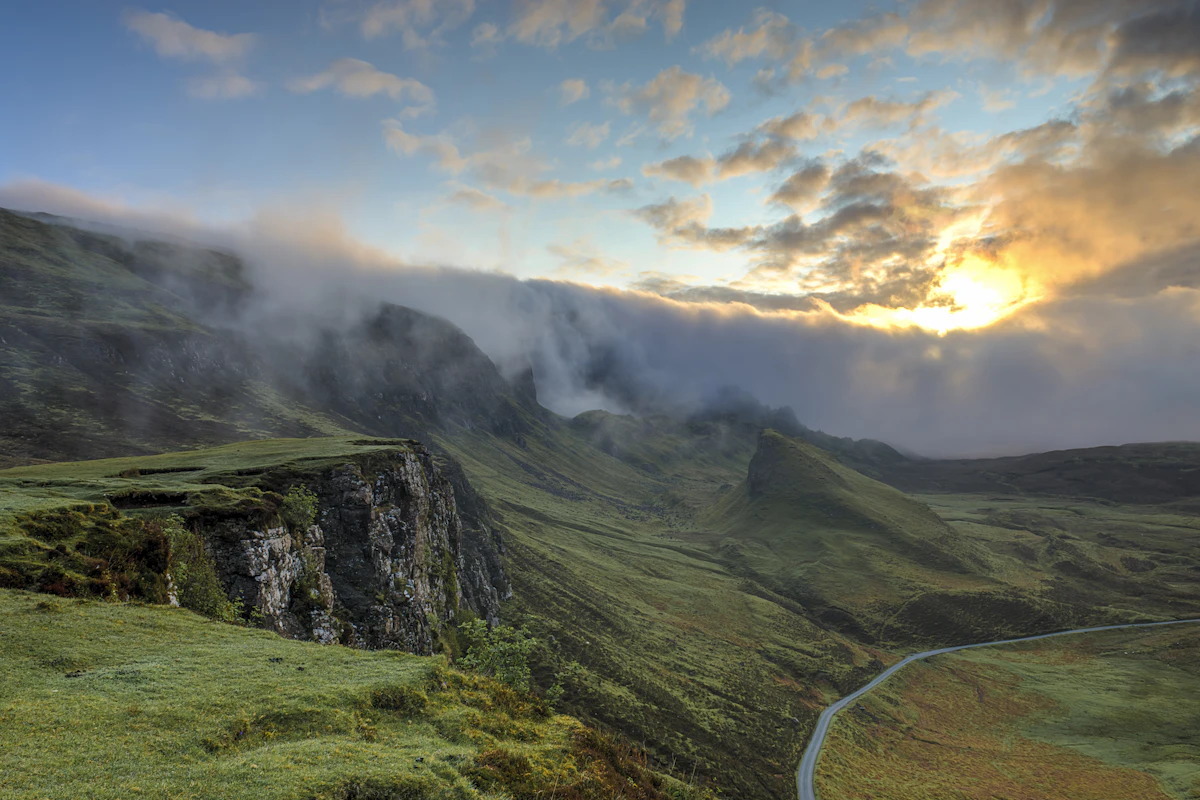
Ha Giang is not a town you visit, it is a road you ride, and everything worth seeing sits along the loop in the order the road gives it. These are the stops that earn getting off the bike, from Ma Pi Leng and the Nho Que river to the Sunday markets.
Ha Giang is not a town you visit; it is a road you ride. Almost everything worth seeing sits along the loop running north out of Ha Giang town through Quan Ba, Yen Minh, Dong Van and Meo Vac, and the stops come in whatever order the road gives them. Which makes the useful question not what to see first, but which places earn getting off the bike and which are fine at 30km/h with the wind in your face. These are the ones that earn the stop.
Ride Ma Pi Leng pass
If Ha Giang has one reason to exist on a travel itinerary, this is it. Ma Pi Leng is a 20km (12-mile) stretch of road cut into a cliff face between Dong Van and Meo Vac, several hundred meters above the Nho Que river. It forms part of what Vietnamese call the Happiness Road, built largely by hand in the 1960s at real human cost, and riding it is the closest thing the country has to a driving pilgrimage. There are pull-in viewpoints along the top; use them rather than stopping on a blind bend, and keep your eyes on the tarmac between them, because the drop is unfenced.
Look down into Tu San canyon, then get on the water
From the pass you are looking into Tu San, a limestone gorge reckoned to be the deepest in Southeast Asia at close to 800m (2,600ft). The view from above is the famous one, but the better experience is the boat. A side road drops from Ma Pi Leng to a jetty on the Nho Que river, where small boats run up into the gorge between vertical walls on water an implausible shade of jade. Allow half a day including the ride down and back, and in flower season arrange a ticket the day before.
Climb the Lung Cu flag tower
Lung Cu marks the northernmost point of Vietnam, a tower on a hilltop near the Chinese border with an enormous flag on top. For Vietnamese visitors this is a place of real patriotic weight, which is worth knowing before you arrive; for a foreign traveler the draw is the climb and the view from the top, out over a valley of terraced fields and stone-walled villages that runs on into China. The steps are steep enough to count as the day's exercise.
Wander Dong Van old quarter and the Sunday markets
Dong Van's old quarter is a short row of century-old rammed-earth houses under tiled roofs, with a few cafes and enough evening life to make it the natural place to spend a night mid-loop. The bigger draw is the market. Dong Van and Meo Vac both hold their main markets on Sunday morning, and these are working markets, full of livestock, produce and textiles, with H'Mong, Lo Lo and Dao families in from surrounding villages. If your dates flex at all, arrange them so a Sunday lands in the middle of the trip.
Day-one stops: Quan Ba, Tham Ma slope and the Vuong mansion
Quan Ba Heaven's Gate is where the road tops out above the valleys and the plateau opens in front of you, with the Twin Mountains, a pair of symmetrical green hills, sitting on the valley floor below. Further north, Tham Ma is the set of switchbacks that turns up in every photo essay about the region, with a viewpoint above it where you can watch the road fold back on itself.
Between Yen Minh and Dong Van, in a small side valley, stands the Vuong family mansion at Sa Phin: a fortified compound built for the H'Mong clan that effectively ruled this corner of the plateau in the early twentieth century on the back of the opium trade. Thick stone walls, timber galleries, an internal courtyard, and a mix of Chinese and local styles. Half an hour walking through it is the best history stop on the loop.
Stay in a village: Lo Lo Chai and Nam Dam
The villages are the part of Ha Giang most travelers under-rate. Lo Lo Chai sits below the Lung Cu flag tower and belongs to the Lo Lo, one of Vietnam's smallest ethnic groups; Nam Dam, near Quan Ba, is a Dao village. Both have homestays, meaning a family house with a few guest rooms where dinner is cooked by the household and eaten at one table, not a hotel with a local name. A night in one turns the trip from a drive into something you actually remember.
A detour if you have a spare day: Hoang Su Phi
West of Ha Giang town, in the opposite direction from the plateau, Hoang Su Phi has terraced hillsides that turn gold around September and mirror the sky when they are flooded in May and June. It does not fit into a standard three-day loop and needs a day of its own, but if terraced rice is high on your Vietnam list, this is the reason to add one.
Order your stops by the road, not by preference. Ride Quan Ba, Yen Minh, Dong Van, Meo Vac and back, and nothing needs backtracking. It also puts Ma Pi Leng and the Nho Que river on day two, once you have found your rhythm on mountain corners.
Practical notes for the stops
- Most viewpoints are free; a few sites charge a small entry fee, payable in cash
- Fill the tank in Yen Minh, Dong Van and Meo Vac, because pumps thin out between towns
- Ask before photographing people, particularly at markets and in villages
- Carry a warm layer for the passes even in summer, since the top of Ma Pi Leng is much colder than the valley
- Do not ride the pass after dark or in thick fog, because the viewpoints will still be there in the morning