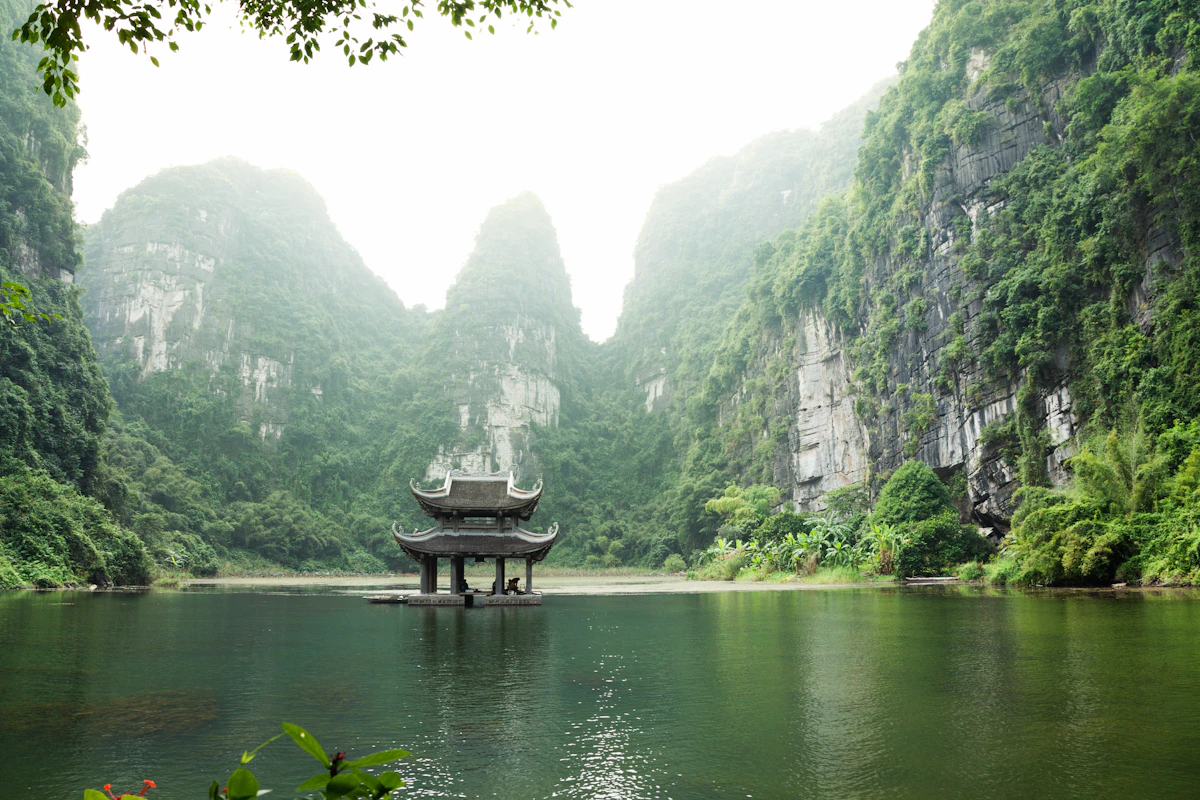
Hai Phong is three cities stacked on top of each other: an island coast to the east, a French-era downtown in the middle, and a belt of old temples around the edges. These are the seven that repay the detour.
Many travelers think of Hai Phong as the place you stop for a bowl of crab noodle soup on the way to Ha Long Bay. Spend a little longer and the city separates into three distinct layers: an island and sea coast to the east, a French-era downtown at the core, and a belt of old temples and battlefield sites around the edges. The 2025 provincial merger added a fourth, inland, to the west. These are the things to do in Hai Phong that actually justify the time.
1. Cat Ba Island and its national park
Cat Ba is the headline attraction and the one that needs the most time. The small town wraps around a working harbor, and just behind it are the three Cat Co beaches, linked by a walkway cut into the cliff face. Cat Ba National Park covers most of the island, with forest walking trails and the critically endangered Cat Ba langur, a monkey that lives nowhere else on earth. Climb to Cannon Fort in the late afternoon and the shape of the whole archipelago falls into place in about ten minutes.
2. Lan Ha Bay
Lan Ha sits directly against Ha Long Bay and shares the same drowned limestone landscape, but with far fewer boats and a scattering of small beaches wedged between the islands. In 2023 UNESCO extended its World Heritage listing to include the Cat Ba archipelago alongside Ha Long. The usual way in is a day or half-day boat tour from Ben Beo pier, combining floating fishing villages, kayaking between the towers and a swim off a quiet beach. Trips run year round, but the water is at its best from late spring to early autumn.
3. Do Son and Hon Dau island
The Do Son peninsula is about 20km (12 miles) from the center, roughly 30 to 40 minutes by road. The water here is cloudy because the river mouth is close, so do not come expecting the blue of the south coast. Come instead to walk, eat seafood and climb the pine-covered hills that look out over the estuary. Boats run from Do Son to Hon Dau, a small island with a French-built lighthouse and a patch of old-growth forest that has been left almost entirely alone.
4. The central strip and the French-era streets
- The Hai Phong Opera House, an early twentieth-century French building, at its best when the lights come on
- Quan Hoa, five small tile-roofed pavilions in front of the theater that have sold flowers for generations
- The Hai Phong Museum on Dien Bien Phu street, an unmistakable Gothic stone block
- Tam Bac Lake and the central gardens, the most pleasant early morning walk in the city
- Dien Bien Phu, Tran Hung Dao and Hoang Van Thu streets, where many old facades survive intact
5. The Bach Dang Giang memorial site
At Trang Kenh in Thuy Nguyen, about 20km north of the center, this complex stands on the bank of the Bach Dang river and honors three generals: Ngo Quyen, Le Dai Hanh and Tran Hung Dao, who each won a naval battle on this stretch of water. What surprises visitors is the atmosphere. There is no entrance fee and no line of vendors, which is rare at a Vietnamese site of this size. Go early or late, because the stone courtyards are wide and there is almost no shade.
6. The old temples in the city
With half a spare morning, three places are worth the taxi fare. Den Nghe is dedicated to Le Chan, the female general who founded the settlement that became this city. Dinh Hang Kenh is a communal house covered in dense, dark wood carving. Chua Du Hang is a working pagoda in a quiet lane. All three sit within the city, ten minutes apart by car, and this is the least touristed part of Hai Phong. Expect local worshippers and almost no other visitors. Dress modestly, which means covered shoulders and knees, and take your shoes off where you see others doing it.
7. Con Son, Kiep Bac and the western district
Since 2025 the Con Son and Kiep Bac complex has been part of Hai Phong city (formerly Hai Duong province). Con Son is associated with the fifteenth-century scholar Nguyen Trai and has streams, pine woods and a stone stairway up to a summit lookout. Kiep Bac honors Tran Hung Dao and is busiest during its spring festival in the first lunar month and its autumn festival in the eighth. The same direction holds the Mao Dien Temple of Literature and the Chi Lang Nam stork island.
On a summer weekend the bottleneck is not hotels, it is the Got ferry terminal. Cross before 9am or after 2pm, and if you are driving, price up the cable car as an alternative rather than spending an hour in a queue in the sun. Losing a morning here costs you the best light of the day on the island.
Practical notes on the things to do in Hai Phong
- Cat Ba needs at least one night. A day trip from the mainland is mostly time spent in transit
- Do Son, Bach Dang Giang and the city center share a short radius, so they combine easily into one day
- Keep Con Son and Kiep Bac as a separate day. Do not pair them with an island crossing
- Sea swimming is realistic from roughly May to September, and worth skipping when a storm is forecast
- Bring shoes with grip for the climb to Cannon Fort and the stone steps at Con Son
- Carry small notes, because temple donation boxes and street stalls do not take cards
- Most of these sights are free or charge only a small entry fee, so the real budget line here is transport, not tickets