Ban Gioc is a long way from anywhere you land, and worth it if you plan the road properly. This guide covers the transport chain from Hanoi, the water seasons, what else in Cao Bang justifies the distance, where to sleep and what the trip costs.
Ban Gioc is the widest waterfall on any of Vietnam's borders, a staircase of water spread across the Quay Son river in the far northeast, with China on the opposite bank. It is also a long way from anywhere a visitor lands: roughly 280-300km (175-190 miles) from Hanoi to Cao Bang city, then another 90km (55 miles) of mountain road. This Ban Gioc Waterfall travel guide covers the transport chain from your arrival in Hanoi, when the falls are worth seeing, what else nearby justifies the distance, where to sleep and what the whole thing costs.
What the falls actually are
The water drops in broad tiers rather than one plunge, across a width that photographs badly and looks far better in person. Because the Quay Son is the border, the falls are shared: the Chinese side calls them Detian and has viewing platforms facing yours. The surrounding country is limestone tower karst, protected as a UNESCO Global Geopark, and this is one of the least visited corners of northern Vietnam as far as foreign travelers are concerned.
Getting there from Hanoi
Everything starts in Hanoi, because there is no airport and no railway at the Cao Bang end. Give yourself a night in the capital after a long-haul flight, then travel north the following evening.
- Overnight sleeper bus from Hanoi: about 6 to 8 hours, an estimated 200,000-300,000d each way (roughly US$8-12)
- Private car with a driver: comfortable and flexible at several times the bus fare, sensible split between three or four
- Day buses run too, but the overnight service saves a hotel night and a daylight day
- Riding a motorbike the whole way from Hanoi is a two-day journey in each direction and only for experienced riders
From Cao Bang city to the falls
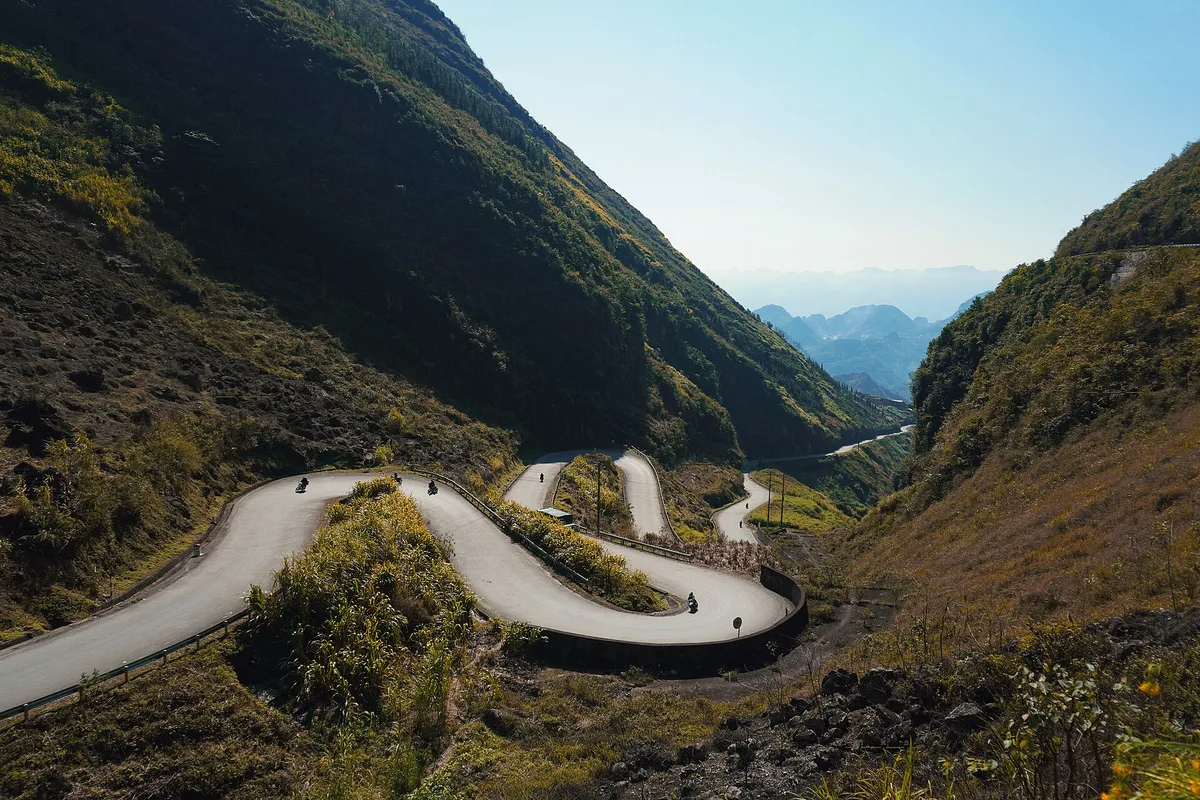
The last 90km (55 miles) takes roughly two to two and a half hours over Ma Phuc pass. Rent a motorbike in the city for an estimated 150,000-250,000d a day (roughly US$6-10) if you ride confidently, or hire a car with a driver for the day, which is what most visitors with limited time should do. Public transport on this leg is slow and limited, and it will not get you to the cave or the stone village afterwards.
When to go
The size of the waterfall depends on the river, which follows the monsoon. Roughly June to September is the high-water season and the falls are at their most powerful, with heavy rain to match. Late September and October combine strong flow with the rice harvest turning gold on the flats below, which is the window most people aim for. Winter is cold, clear and thin on water, and March to May is the low point of the year.
How long to give it
Three days and two nights is the standard: a night bus up, a day around Cao Bang city and Pac Bo, a day for the falls and the cluster of sights beside them, then the road home. Four days adds Thang Hen lake and Mat Than mountain plus a buffer for weather. Two days is possible but you will spend most of it moving, and you will see the waterfall at its busiest hour.
What else justifies the distance
- Nguom Ngao: a long lit limestone cave roughly 10 minutes from the falls
- Khuoi Ky: a Tay village of stacked stone stilt houses about 3km (2 miles) away
- Pac Bo: the 1941 base of Ho Chi Minh, 55km (35 miles) beyond Cao Bang city
- Thang Hen lake and Mat Than mountain, a ridge with a natural hole punched through it
- Ma Phuc pass and the geopark scenery on every drive you make
Where to sleep
- Cao Bang city: guesthouses at an estimated 250,000-400,000d (US$10-16), three-star hotels 600,000-1,000,000d (US$24-40)
- Trung Khanh town, about 20km (12 miles) from the falls: small hotels roughly 300,000-600,000d (US$12-24)
- At the falls: a resort from around 1,500,000d (US$60), smaller guesthouses roughly 500,000-900,000d (US$20-36)
- Khuoi Ky homestays: shared rooms an estimated 120,000-200,000d per person (US$5-8), private rooms 400,000-700,000d (US$16-28)
Sleep the night before your waterfall morning as close to the falls as you can, whether that is Trung Khanh, the falls themselves or Khuoi Ky. The room costs a little more than one in Cao Bang city, and it saves a 5am start and 90km of pass road, which is the difference between arriving in the empty first hour and arriving with the coaches.
What a trip costs
As a per person estimate for three days and two nights, traveling independently and sharing transport with at least one other person.
- Return sleeper bus from Hanoi: roughly 400,000-600,000d (US$16-24)
- Two days of motorbike hire or a shared car with a driver: roughly 500,000-900,000d (US$20-36)
- Two nights of accommodation: roughly 400,000-1,200,000d (US$16-48)
- Entry tickets, food and drink: roughly 600,000-1,000,000d (US$24-40)
- Total: roughly 1,900,000-3,500,000d per person (US$75-140)
Visas, money, phones and the border
Most travelers from the US, UK, Australia, Canada, Ireland and New Zealand enter Vietnam on an e-visa applied for online before departure. Check the current rules on the official government immigration portal rather than a booking site, and allow time before your flight. Draw cash in Hanoi or Cao Bang city, because ATMs thin out beyond Trung Khanh. A local SIM or eSIM is cheap, with decent coverage on the main roads and patchy signal in the villages.
Ban Gioc Waterfall travel guide: what to sort first
- Book the Hanoi to Cao Bang bus a few days ahead in autumn and around Vietnamese public holidays
- Reserve the night nearest the falls first, since Trung Khanh and Khuoi Ky have very few rooms
- Decide early between renting a motorbike and hiring a car with a driver
- Draw cash in Hanoi or Cao Bang city and carry small notes for stalls and tickets
- Carry your passport at the waterfall, which sits in a working border area
- Pack a warm layer for winter and a rain shell for summer, whatever the coastal forecast says