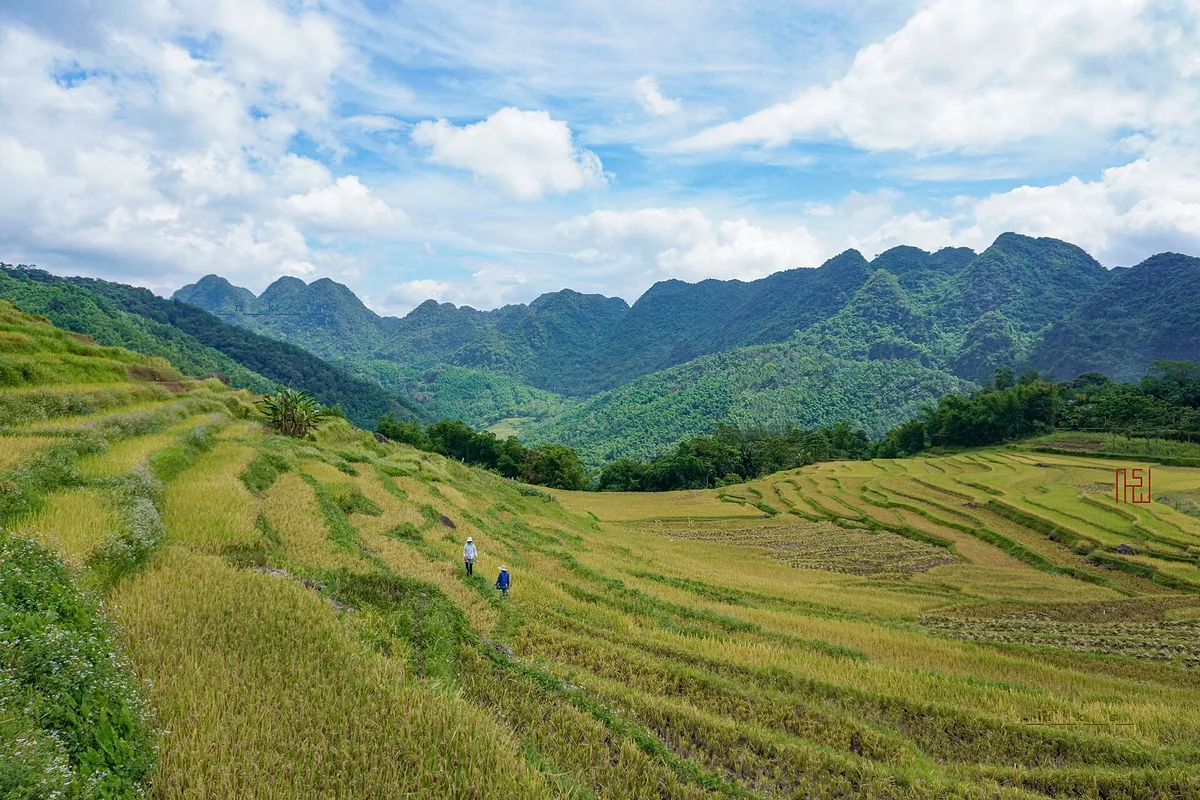
Nothing in Pu Luong was built for visitors, which is the appeal and also the problem if you like a list. These are the villages, the waterfall, the cave, the market and the walks that justify the four-hour drive from Hanoi, ordered by how easy each is to reach.
Nothing in Pu Luong was built for visitors, which is both the appeal and the problem if you like a list to work through. The things to do in Pu Luong are villages, a waterfall, a cave, a twice-weekly market and the mountain roads that connect them, spread across a nature reserve of terraced rice and limestone about 160-180km (roughly 100-110 miles) southwest of Hanoi in Thanh Hoa province. What follows is ordered by how easy each one is to reach, with an honest note on what getting there involves.
Ban Don and the terraces everyone photographs
If you have seen an image of Pu Luong with curved rice terraces stacked up a hillside and a few stilt-house roofs among them, it was almost certainly Ban Don. This is where most of the accommodation is, the access road is good and a normal car reaches the village. The best view is not from the valley floor but from the concrete lane that loops around the hillside behind the village: 20-30 minutes of walking gets you a view over the whole basin, and it is worth doing at dawn or in the last hour of light.
Hieu waterfall and the village beside it
The stream at Ban Hieu emerges from limestone and carries a heavy load of calcium, which it deposits as chalky white shelves of rock. The result is a waterfall that drops through the hamlet in a series of stages rather than one plunge. You follow a footpath up beside the water from the bottom to the top, which takes 20-30 minutes and includes some genuinely slippery sections. Stilt houses sit right on the bank, and lunch here comes with the sound of running water throughout the meal.
Kho Muong and its bat cave
Kho Muong is a village on the floor of a closed valley, reached by a long descent from a saddle, so the entire settlement appears below you the moment you clear the top of the pass. There are very few services here, which is exactly why people come. At the edge of the village is a large limestone cave with stalactites and a resident bat colony living inside. You need a torch and shoes with grip, because the entrance is dark, damp and uneven underfoot.
Son Ba Muoi, the plateau that stays cool
The three villages of Son, Ba and Muoi sit together on a small high plateau, well above the rest of the reserve, so the temperature runs several degrees lower: comfortable in high summer and thick with fog in winter. Vietnamese travelers sometimes call it the Sapa of Thanh Hoa, which oversells it, though the emptiness and the clean cold air are real. The road up is a narrow, steep pass, so think hard before riding it yourself and hire a local driver if there is any doubt.
Trekking to the top of the reserve
The highest point in the reserve stands at around 1,700m (roughly 5,600 feet) and is the main trekking route in the area. The path climbs through old-growth forest and open grassland, and up and back generally fills an entire day depending on where you start. This one is not a do-it-yourself walk: a local guide is required, the trails branch repeatedly, and phone signal comes and goes. Your accommodation can arrange a guide, and the rate is negotiated by route.
Pho Doan market, Thursdays and Sundays
Twice a week people come down from the surrounding villages with wild greens, bamboo shoots, stone snails, chickens and ducks. The market is small and you can walk it in half an hour, but it is the least staged thing in the reserve and the best half-hour of the trip for many people. Go early, roughly between six and eight in the morning, because by late morning the stalls are packing up and the crowd has gone home.
The waterwheels and the roads in between
Scattered along the streams are the giant bamboo waterwheels that farmers use to lift water from the stream up into the terraces. They are not on any list of attractions and no one charges to see them, yet they are the thing that makes driving around Pu Luong more interesting than driving anywhere else. Stop when something looks good rather than working toward the next named place: on these roads that is not laziness, it is the correct method.
Do not try to squeeze all six places into two days. Roads inside the reserve are short on a map and made entirely of climbs and blind bends, so 20km (12 miles) can take close to an hour. Pick a maximum of two places a day and leave the rest of the time for walking around a village on foot, which is the best part anyway.
Things to do in Pu Luong by how long you have
- One day: Ban Don in the morning, Hieu waterfall in the afternoon
- Two days and one night: add Kho Muong and the bat cave on the second day
- Three days and two nights: add Son Ba Muoi, or a half-day walk between villages
- Four days or more: give a whole day to the summit trek with a local guide
- Any Thursday or Sunday: slot Pho Doan market in at the very start of the morning
Practical notes
- Carry cash: there are no ATMs in the villages and few places take cards
- Wear shoes with grip for the waterfall and the cave, and pack a small torch
- Phone signal is patchy in the closed valleys, and lodge wifi drops in heavy rain
- Arrive and travel in daylight, because the mountain roads have no lighting at all
- Ask your hosts to arrange a motorbike taxi for anything you would rather not ride yourself