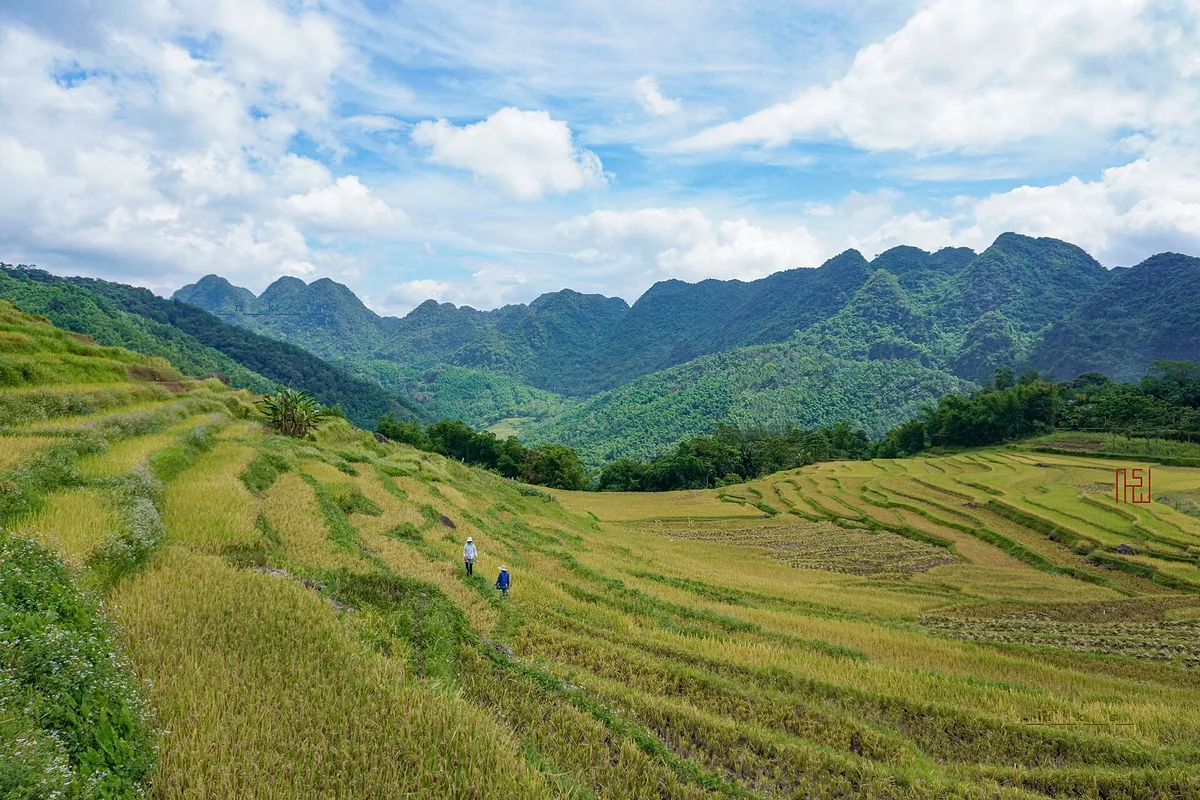
Pu Luong grows two rice crops, so the terraces turn gold twice a year rather than once. Here is what each season actually delivers, from the September harvest to the empty misty winter, and how the weather changes the mountain road in.
Pu Luong is a nature reserve of terraced rice, bamboo waterwheels and villages of the Thai and Muong ethnic minorities about 160-180km (roughly 100-110 miles) southwest of Hanoi, in Thanh Hoa province. Almost everything you came to photograph is a farming calendar rather than a fixed landscape, which makes the best time to visit Pu Luong an unusually answerable question. The valley is low enough to grow two rice crops a year instead of the single crop that governs Sapa, so the terraces turn gold twice, and the rest of the year splits cleanly into a wet green season and a dry cold one.
Why Pu Luong has two harvests and Sapa has one
Most of the famous terraced landscapes in northern Vietnam sit high enough that farmers manage one rice crop a year, cut in September. Pu Luong is lower and warmer, so the valley floor ripens in late May and again in late September. Between those two short windows the fields are either bare mud or bright green, both pleasant and neither of them the image that brought you here. The ripening dates move by a week or two each year with the weather, which matters more than any other piece of planning.
Late September to early October: the best time to visit Pu Luong
If you only get one attempt at this, take the autumn harvest. The second crop ripens just as the northern summer breaks, so you get gold terraces, clear skies, mist pooling on the valley floor at dawn and soft light across the fields in the late afternoon. It is also the busiest fortnight of the year. Rooms in Ban Don, the main village and the one in most of the photographs, often go weeks ahead, and weekends sell out first. Book early or take a bed in a quieter hamlet and ride in.
Late May to early June: the first harvest, with fewer people
The first crop ripens for around two weeks in late May before it is cut. The color is the same gold, the crowds are noticeably thinner and the days are long enough to fit more walking into them. The trade-off is heat, because midday in the valley in early summer is genuinely hot and glaring. Plan your walking and your photography for early morning and late afternoon, and spend the middle of the day on the shaded deck of a stilt house, which is what the farming day does here anyway.
June to August: green terraces, full waterfalls, afternoon rain
After the first cut the fields are replanted and the whole valley turns a soft bright green. This is the water season. The streams run hard, Hieu waterfall is at its most impressive, and the pools at the hillside lodges are pleasant to sit in rather than decorative. It is also the wet season: rain tends to arrive fast in the afternoon, the mountain road gets slick, and small landslips do happen. None of that ruins a trip, but do not build a schedule with no slack in it.
November to February: dry, quiet and cold
The fields are cut and bare so the color has gone, and plenty of people prefer this stretch anyway. The road is dry, rain is rare, prices soften and the reserve is close to empty. It is the best trekking window of the year because you are not walking in heat, and low cloud settles into the valley on winter mornings in a way that is worth getting up for. Nights get properly cold, especially on the Son Ba Muoi plateau, so bring a real jacket rather than a fleece.
March and April: the easy shoulder
Warm, stable, green and uncrowded. Nothing about the scenery is spectacular in these two months, but nothing is difficult either. The road is good, the weather is predictable, rooms are cheap and available, and the reserve is quiet enough that you hear the waterwheels turning. If you are traveling with children or older parents, or you simply want two days of doing very little on a balcony above a valley, this is the most comfortable time of year to be here.
What the season does to the road in
Pu Luong is reached on a mountain road, usually through Hoa Binh and Mai Chau, and the final stretch is steep, narrow and full of blind corners. In the dry months it is straightforward in a car. In heavy summer rain it wants a driver who already knows it, and the climb to the Son Ba Muoi villages is not something to attempt on a rented motorbike in the wet. Whatever the season, aim to arrive in daylight, because there is no street lighting anywhere in the reserve.
Do not book flights around somebody else's photograph from last year. The harvest shifts by a week or two depending on the weather, and turning up four days late means turning up to stubble. Message the place you are staying and ask what stage the rice around the village has reached right now. They only have to look out of the window to tell you.
How the seasons fit a two-week Vietnam trip
Pu Luong competes for the same slot as Sapa, Ha Giang and Ninh Binh rather than adding to them, and the season is a fair way to choose between them. During the autumn harvest Sapa is spectacular and crowded, while Pu Luong is the warmer, quieter version of the same idea at half the travel time from Hanoi. In midwinter, when the far northern mountains are cold and gray, Pu Luong is still comfortable. In the summer rains, flat and much closer Ninh Binh is the easier bet.
Quick picks by what you want
- Gold terraces and the best light: late September to early October, booked several weeks ahead
- Gold terraces without the crowd: late May to early June, walking early and late to dodge the heat
- Waterfalls at full flow and pools worth using: June to August, with a spare afternoon for rain
- Empty valleys, soft prices and cool walking: November to February, with warm layers for the nights
- Easiest conditions for families or a slow break: March and April
- Market mornings in any season: Pho Doan market runs on Thursdays and Sundays, best before 8am