The old town at 7am, cao lau for lunch, a craft village in the afternoon and lanterns on the river after dark. What actually fits into a single day, and what does not.
Hoi An is the stop most English-speaking visitors to Vietnam end up naming as their favorite, and the reason is that the old town is small, walkable, low and almost entirely intact. It also means the place is crowded from mid-morning until late evening. Getting one day in Hoi An right is mostly a question of timing: be in the old town before the tour buses, get out of it in the heat, and come back for the lanterns. Here is the day, hour by hour.
Getting there, and when to come
Almost everyone arrives from Da Nang, roughly 30km (19 miles) north, where the airport for central Vietnam is. Hoi An is now administered as part of Da Nang city after the 2025 provincial merger dissolved Quang Nam, which changes the paperwork and nothing else. Come between February and August if you can choose; September to November is the flood season and the old town takes standing water most years.
- Taxi or ride-hail from Da Nang: an estimated 300,000-450,000d (roughly US$12 to 17) one way
- Public bus number 01: around 30,000d, cheap, slow and busy
- Rented motorbike: an estimated 120,000-150,000d (roughly US$5 to 6) a day along the coast road
- Old town ticket: an estimated 120,000d (roughly US$5), covering entry to several heritage sites
7am to 11am: the old town while it is empty
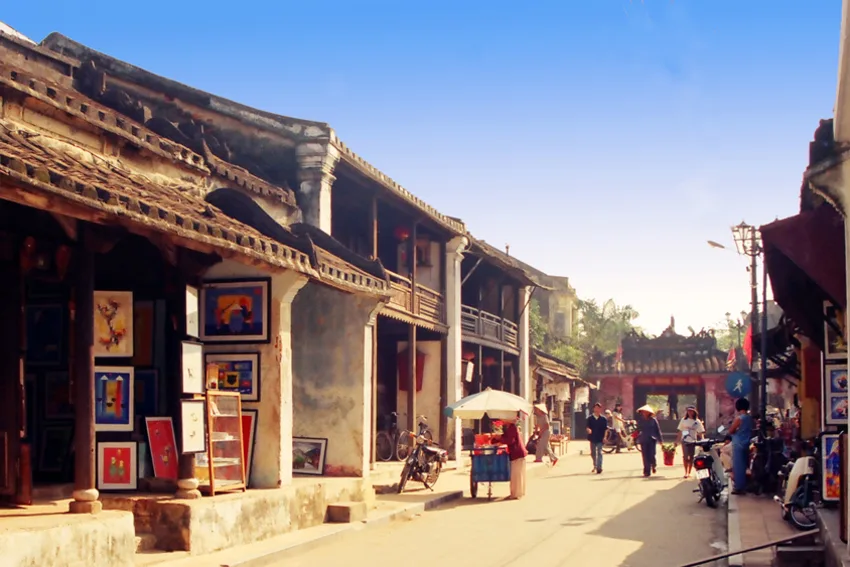
Be walking by seven. For two hours the streets belong to people opening shutters, sweeping and setting out breakfast, and you can photograph the yellow walls and tiled roofs without a crowd in the frame. Start at the Japanese Covered Bridge, a roofed timber span built by Japanese merchants in the early 1600s, printed on the 20,000d banknote and guarded at either end by stone monkeys and dogs.
Work east from there. The Tan Ky and Phung Hung houses are merchant homes over two centuries old, still lived in, with flood marks on the interior walls that tell you more about this town than any museum caption. The Fujian assembly hall is loud with color and hanging incense coils. Buy breakfast at the market on the riverfront rather than at a cafe.
Everything you have seen in photographs of this town was taken before eight in the morning or after eight at night. The middle of the day is a different and much busier place.
11am to 2pm: the food, which is the point
Hoi An has dishes that exist nowhere else, and this is the meal to plan properly. Cao lầu is the local one: thick, chewy, faintly smoky noodles, traditionally made with water from one particular well, served with slices of pork, fresh greens and crisp crackling, with only a spoonful of broth. An estimated 30,000-50,000d (roughly US$1.20 to 2) a bowl.
- Cao lầu: the dish to order first, an estimated 30,000-50,000d
- Com ga: shredded chicken with turmeric-yellow rice, herbs and chili, an estimated 35,000-55,000d
- Bánh mì: a baguette sandwich this town does exceptionally well, an estimated 25,000-40,000d
- White rose dumplings and fried wontons: local snacks, an estimated 40,000-70,000d a plate
- Che bap: a sweet corn pudding, the standard finish, an estimated 15,000-30,000d
Take the early afternoon off. The heat between noon and three is real, the old town is at its most crowded, and the day gets much better if you sit somewhere cool for an hour.
2:30pm to 5:30pm: get out of the old town
The craft villages on the edge of town are the counterweight to the old streets, and both are about 3km (2 miles) out, an easy bicycle ride at an estimated 30,000-50,000d for the day. Thanh Ha pottery village has been working clay for more than five hundred years and lets you throw a pot yourself; entry is an estimated 35,000d. Tra Que herb village is a grid of vegetable beds where you can plant, water with the traditional shoulder-carried cans and eat what is growing, also around 35,000d.
If you would rather be on water, the Bay Mau coconut palms at Cam Thanh run round basket-boat trips through the waterways for an estimated 150,000d. Be warned that the busier operators have turned this into a loud spinning-boat show; ask for a quiet paddle if that is not what you want.
6pm to 9:30pm: lanterns on the river
This is what people remember. As the light goes, silk lanterns come on across the whole old town and along both banks of the Hoai River, and the streets turn orange. Walk the riverfront, watch a game of bai choi, the sung bingo-like street game played on the far bank, and eat again.
Floating paper lanterns with a candle inside cost an estimated 10,000-20,000d and are launched from the steps and from boats. A rowed boat out onto the river runs an estimated 150,000-200,000d for a few people, and seeing the town from the water is worth the fare. On the full moon of each lunar month the old town switches off its electric lights entirely.
What one day in Hoi An costs
- Old town ticket: an estimated 120,000d (roughly US$5)
- Three meals and drinks: an estimated 200,000-350,000d (roughly US$8 to 13)
- Bicycle for the day: an estimated 30,000-50,000d
- Craft village entry: an estimated 35,000d
- Lantern and a share of a boat: an estimated 60,000-120,000d
- Total per person, excluding accommodation and transport from Da Nang: an estimated 500,000-800,000d (roughly US$19 to 31)
Practical notes
- Wear flat shoes, because the old town is cobbled and you will walk most of the day
- Park at the edge of the pedestrian zone; the center is closed to vehicles for much of the day
- Carry cash, since the small kitchens and street sellers rarely take cards
- Haggle gently on souvenirs, where 20 to 30 percent off the first price is normal
- Check the forecast in autumn, when the river rises quickly and the old town closes