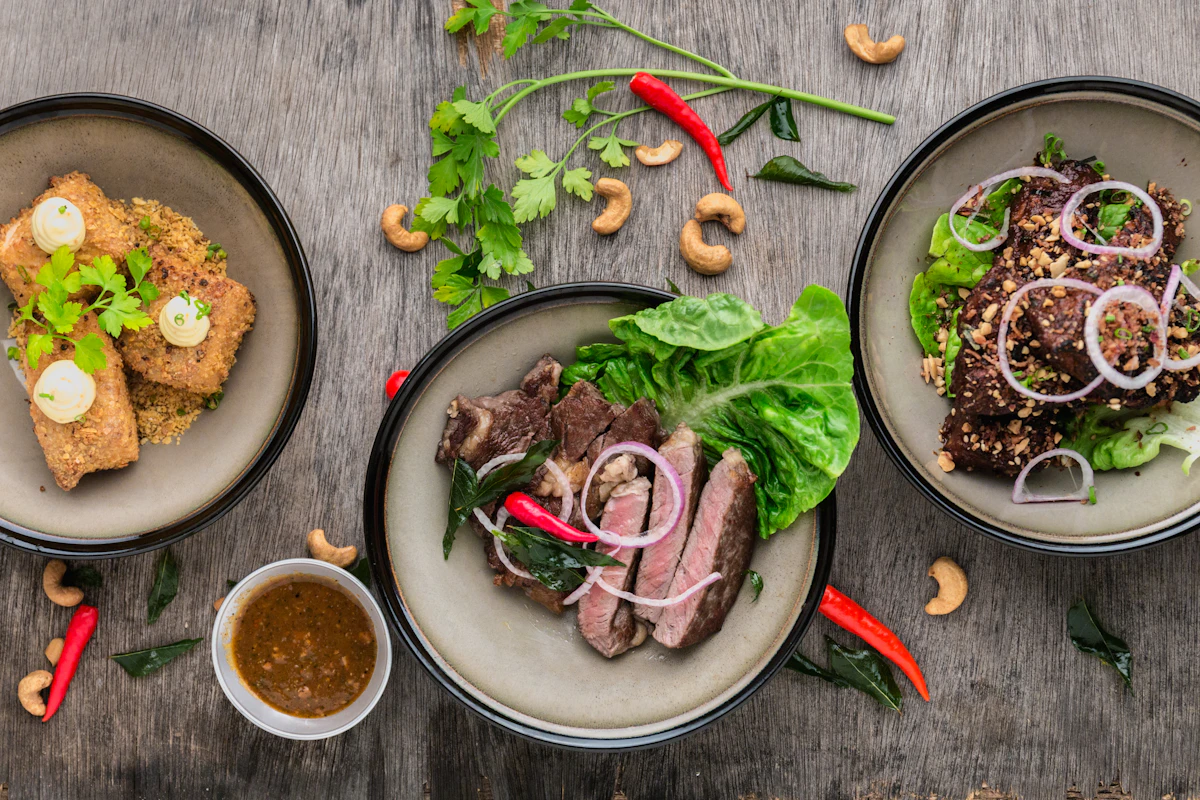
There is almost nothing to eat at the falls themselves, so the real question is what to eat in the region around them. Border cooking: rice rolls in bone broth, cold sour noodles, seven-spice roast duck and a chestnut people drive a long way for.
There is very little to eat at the waterfall itself, so "what to eat in Ban Gioc Waterfall" really means what to eat in the region around it, and Cao Bang turns out to be one of the more distinctive food areas in northern Vietnam. This is border cooking: roast meats with clear Chinese influence, river fish, sticky rice, sour dressings, and a chestnut that Vietnamese travelers drive a long way for. Here is what to look for, what each dish actually is, and which months it exists in.
The honest answer to "what to eat in Ban Gioc Waterfall"
Eat in Cao Bang city at either end of your trip and in the town of Trung Khanh on the day you visit the falls. At the waterfall itself there are a handful of stalls and the restaurants attached to the accommodation, and that is all. If you are staying in a homestay near the water, the best meal of the trip is likely to be the one your hosts cook, and it needs ordering hours in advance.
Banh cuon, the Cao Bang version
Banh cuon is a sheet of steamed rice batter rolled around minced pork, eaten across Vietnam with a small bowl of dipping sauce. Cao Bang does it differently: the rolls arrive sitting in a bowl of hot pork bone broth with sliced sausage and spring onion, which turns a snack into a proper breakfast. On a cold mountain morning it is the best thing in the region. It is strictly a breakfast dish, so look for it before about 10am or you will miss it entirely.
Pho chua, the cold sour noodle plate
Pho chua translates as sour pho, but it is not a soup at all. Flat rice noodles are served at room temperature and topped with roast pork or duck, fried sweet potato, peanuts and herbs, then dressed with a sweet-sour sauce you toss through yourself. It is a lunch dish, refreshing rather than heavy, and one of the few things you will struggle to find anywhere outside this corner of the country.
Vit quay 7 vi and roast suckling pig
Vit quay 7 vi is duck marinated in seven spices and roasted until the skin crackles, and it is the dish Cao Bang is proudest of. The marinade goes into the cavity as well as onto the skin, so the flavor carries all the way through the meat rather than sitting on the surface. Lon sua quay, roast suckling pig, is the celebration version of the same technique. Both are sold by weight at roast meat shops and eaten with rice, herbs and a dipping sauce.
Trung Khanh chestnuts, and when they exist
Hat de Trung Khanh, the chestnuts grown around the town of Trung Khanh on the road to the falls, are the region's most famous product: large, thick-shelled and sweeter than the imported nuts sold elsewhere in Vietnam. They are strictly seasonal, roughly in autumn, and roasted at the roadside while you wait. This is the standard thing to carry home, and it is also the reason autumn is the most popular time to make the trip.
Eat banh cuon on the morning you drive out to the falls, not on the morning you leave. Almost every place selling it in Cao Bang city has closed by mid morning, and the day you leave will be the day your bus timing makes you miss it.
Banh ap chao and cold-weather food
Banh ap chao appears when the temperature drops. It is a fritter of glutinous rice batter with duck meat inside, deep fried to order and eaten hot with pickled vegetables and a dipping sauce, usually from a street stall on a winter evening. It exists because Cao Bang winters are genuinely cold, and it is the correct thing to eat after a day on a motorbike over Ma Phuc pass.
Xoi tram, smoked meat and corn liquor
- Xoi tram: sticky rice steamed with black canarium fruit, which stains it purple and tastes faintly of olive
- Thit trau gac bep: buffalo meat salted, spiced and hung over the kitchen fire until dry, then torn into strips
- Roast pork and grilled river fish, standard on any homestay dinner table
- Corn liquor and local rice spirits, poured generously by hosts and best treated with caution
- Foraged greens and bamboo shoots, which change with the season rather than with the menu
Eating at a homestay near the falls
In the stone village of Khuoi Ky and around Trung Khanh, homestay dinners are served family style at one table: several dishes, rice, a soup and whatever is good that week. Order it in the afternoon rather than at dinner time, because your hosts shop for the number of guests. Expect an estimated 120,000-200,000d per person (roughly US$5-8), and say in advance if you do not eat meat, which is otherwise assumed. Breakfast is simpler, usually rice porridge, eggs or noodles, and it is included at some places and charged separately at others.
Ordering, prices and what to take home
- A bowl of banh cuon or a plate of pho chua: an estimated 30,000-60,000d (roughly US$1-2.50)
- A homestay dinner: roughly 120,000-200,000d per person (US$5-8)
- Roast duck is sold by weight, so order a portion rather than a whole bird for two people
- Chestnuts and smoked buffalo are the usual things to take home, bought in town rather than at the falls
- Carry cash and small notes, since almost nowhere outside Cao Bang city takes a card
- Roast meat shops are easiest to order from by pointing, since English menus are rare outside Cao Bang city