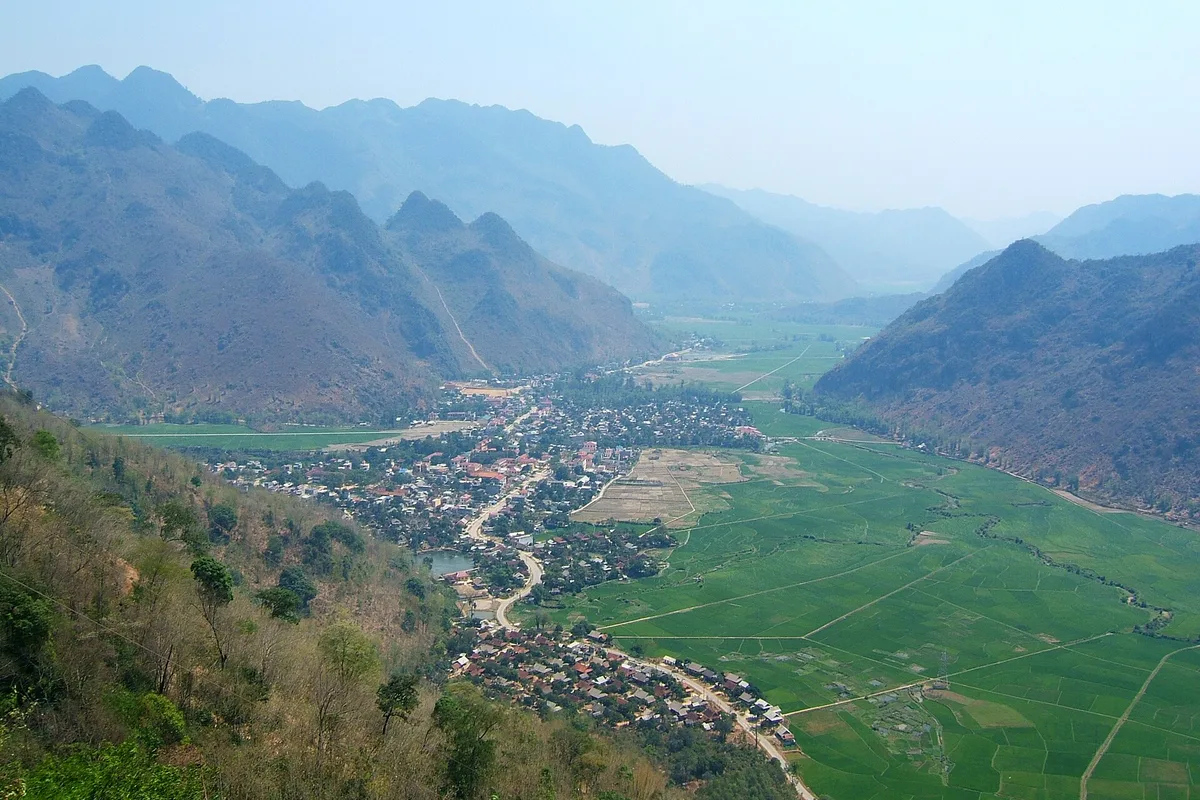
Mai Chau is the easiest overnight escape from Hanoi that still feels genuinely rural: a flat valley of rice paddies and wooden stilt houses about 140km west of the city. This covers transport, timing, sleeping, eating and costs.
Mai Chau is a flat valley of rice paddies and wooden stilt houses about 140km (roughly 87 miles) west of Hanoi, and it is the easiest overnight escape from the capital that still feels genuinely rural. This Mai Chau travel guide covers the practical side for a first-time visitor arriving from abroad: how to get there from Hanoi, when to come, where to sleep, what things cost, and how it fits into a two-week itinerary already crowded with Ha Long Bay and Hoi An.
What Mai Chau actually is
A wide, flat valley floor planted almost entirely with rice, ringed by limestone hills, with a scattering of villages built by the White Thai, one of Vietnam's 54 recognized ethnic groups, whose houses stand on wooden posts with the living space upstairs. Two villages, Ban Lac and Pom Coong, take nearly all the visitors. There is no old town, no beach and no headline monument. The valley has hosted guests since the 1990s, so it is comfortable and practiced rather than remote. The area sat for decades in Hoa Binh province; Vietnam merged and renamed a number of provinces in 2025, so newer maps may label it differently.
What this Mai Chau travel guide assumes about your trip
That you land at Hanoi's Noi Bai airport after a long flight, spend two or three days in the city, and then have one rural slot to fill before heading further north or flying south to Hoi An. Mai Chau is a two-night trip inside that slot. It competes with Ninh Binh, which is closer and has far bigger scenery, and with Pu Luong, which is wilder and harder to reach. Mai Chau wins on ease: no overnight train, no permit, no serious hiking, and a village stay you can arrange in a morning.
Getting there, and getting around
- Public bus: about four to five hours on Highway 6 from Hanoi's western bus stations, an estimated 100,000 to 160,000d each way (roughly US$4 to 6.50). Buy a day ahead in high season
- Tourist minibus or private car: three to four hours, hotel pickup, much more expensive but far simpler with luggage
- Small-group tour from the Old Quarter: transport, homestay and meals bundled, sensible if you would rather arrange nothing
- Motorbike: popular with Vietnamese riders, but Thung Khe Pass is steep, foggy and full of trucks, and most travel insurance excludes riders without the correct license
- There is no train and no airport; the road crosses one mountain pass each way
Bicycles. The valley is flat, the distances are small, and every homestay rents them for an estimated 50,000 to 100,000d a day (roughly US$2 to 4). A motorbike at an estimated 120,000 to 200,000d a day (US$5 to 8) only makes sense if you plan to reach Go Lao Waterfall or push on toward Pu Luong. Walking covers both main villages easily. Taxis are scarce, ride-hailing apps do not function out here, and your homestay is the usual way to arrange a car.
When to go
The valley grows two rice crops, so it turns gold twice a year: roughly late May into June, and late September into October. Those are the most photogenic weeks and the busiest. March and April bring bright green young rice and the best cycling weather, along with white ban blossom and Thai new-year festivities. November to February is cool, misty, quiet and cheap, with bare fields. July and August are wet, and prolonged rain occasionally slows the pass road, so leave slack in your plans.
Where to sleep
Three broad choices. A traditional stilt house in Ban Lac or Pom Coong, where you sleep on a mattress on the wooden floor, often in a row behind mosquito nets, runs an estimated 100,000 to 200,000d per person. A private room or a rice-field bungalow runs roughly 300,000 to 1,000,000d a night (about US$12 to 40). Eco-lodges and resorts start around 1,000,000d (US$40) and climb, offering pools and privacy but less contact with village life. Book ahead for harvest weekends and Vietnamese public holidays.
What to eat
Dinner at your homestay is the meal that matters, at an estimated 150,000 to 250,000d a head (roughly US$6 to 10) for a shared spread. Expect com lam (sticky rice roasted inside a bamboo tube), grilled free-range hill chicken, small stream fish grilled whole, wild greens, bitter bamboo shoots and cham cheo, a dip of salt, chili and wild mountain pepper. Buffalo simmered with a sour wild leaf is the local specialty. The drink is ruou can, rice wine fermented in a jar and drunk through long bamboo straws.
What a trip costs
- Return transport from Hanoi: roughly 200,000 to 320,000d (US$8 to 13) by public bus
- Stilt-house bed: roughly 100,000 to 200,000d per person per night (US$4 to 8)
- Bicycle roughly 50,000 to 100,000d a day, motorbike roughly 120,000 to 200,000d
- Homestay dinner: roughly 150,000 to 250,000d a head, drinks on top
- Cave entry tickets: roughly 20,000 to 50,000d each
- Two days and one night, done simply: roughly 800,000 to 1,500,000d per person (US$32 to 60)
Etiquette in the villages
- Ask before photographing people, and accept a refusal
- Shoes come off before you climb the steps into a stilt house
- Dress modestly around the villages, which are homes rather than a resort
- A few words of Vietnamese go a long way, though many hosts speak some English
The single biggest upgrade to a Mai Chau trip costs nothing: make it a night, not a day trip. Everything people remember here happens outside the hours a day tour is in the valley, whether that is mist over the paddies at six, the village before the buses arrive, or a dinner that runs three hours.
Before you go
- Book your homestay ahead in harvest season, at weekends and around Lunar New Year
- Arrange your return seat to Hanoi when you arrive, not on your last morning
- Pack a fleece for evenings between November and March, since stilt houses are open to the air
- Bring insect repellent, a light rain layer and shoes you do not mind getting muddy
- Check Vietnam's e-visa requirements for your nationality well before you fly
- Draw cash in Hanoi, since the valley has few machines and takes no cards at village level