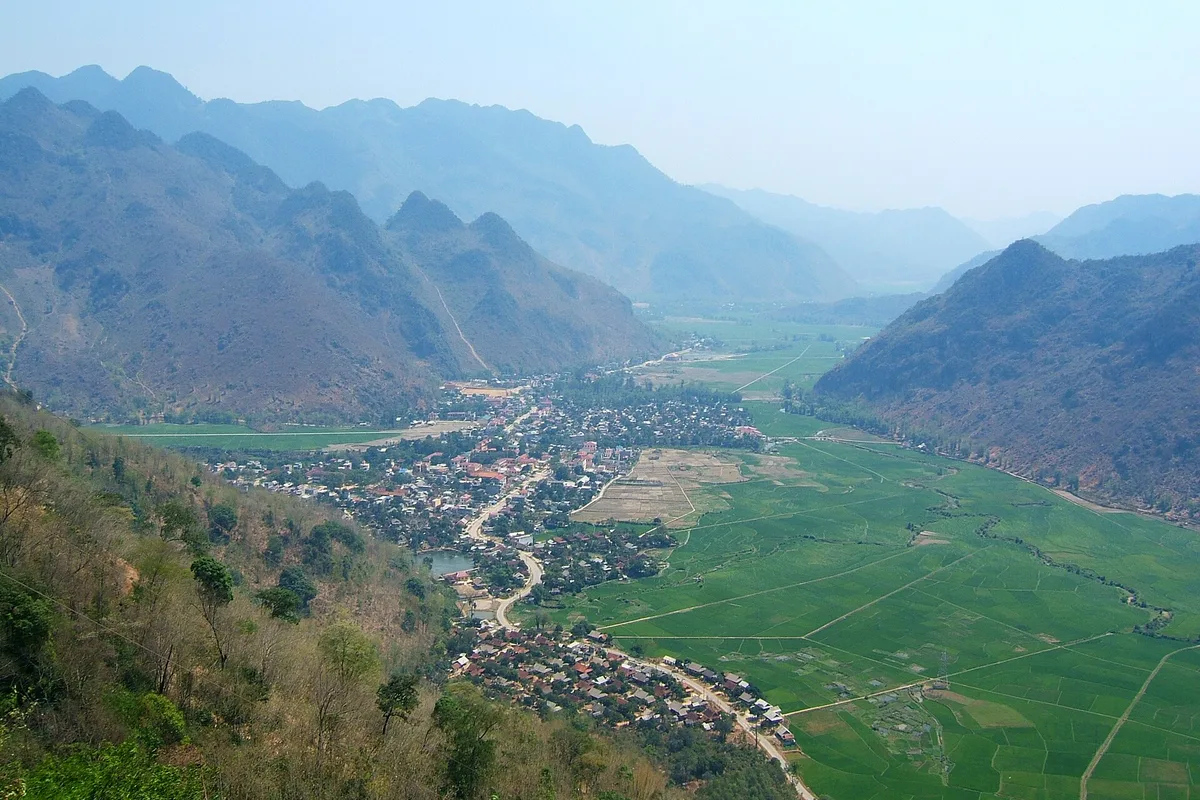
The list of sights in Mai Chau is short, and that is the point. Here is what genuinely earns your time in a day and a half in the valley, roughly in the order you would do it.
There is a short list of things to do in Mai Chau, and that is precisely the appeal. The valley is a flat green floor of rice paddies about 140km (roughly 87 miles) west of Hanoi, ringed by limestone hills and dotted with the stilt-house villages of the White Thai, one of Vietnam's officially recognized ethnic minority groups. Nobody comes here to work through a checklist. What follows is what genuinely earns your time across a day and a half, arranged roughly in the order you would end up doing it.
Ban Lac and Pom Coong, the villages you sleep in
Ban Lac is the best known village in the valley and has been receiving visitors for three decades, which cuts both ways: the welcome is practiced and comfortable, and the main lane is lined with textile stalls. Pom Coong, a few minutes' walk away, is quieter and less commercial while offering the same experience. Both are villages of traditional wooden houses raised on posts with the living space upstairs, and sleeping in one is the central event of a Mai Chau trip rather than a novelty add-on.
- Sleep upstairs on a mattress on a polished wooden floor, often in a row behind mosquito nets
- Watch weavers working brocade at looms beneath the houses, and buy directly from them
- Eat dinner with the household at a low table, usually arranged with the room
- Expect the villages to be busy in the afternoon and quiet again by nine in the evening
Cycle the rice valley, which is the best of it
If you do one thing here, do this. The valley floor is flat, the lanes between the paddies are barely wide enough for a car, and every homestay rents bicycles for an estimated 50,000 to 100,000d a day (roughly US$2 to 4). An hour of aimless riding gets you water buffalo in the fields, families planting or cutting depending on the month, and the ring of hills on every side. Early morning, when mist is still sitting on the paddies, is when the valley looks the way it does in the photographs.
Climb to Chieu Cave for the view
A steep stone stairway of several hundred steps climbs the hillside behind Mai Chau town to Chieu Cave, a chamber of stalactites lit for visitors. The cave is pleasant enough; the reason to make the climb is the view from the mouth, which takes in the entire valley floor with the villages laid out across it. Entry is a small ticket in the region of 20,000 to 50,000d (well under US$2). Go early or late, because the stairs are hard work in the middle of the day.
Mo Luong Cave and Go Lao Waterfall
Two more natural sights will fill an afternoon. Mo Luong Cave is a larger, easier cave system with dramatic stalactite chambers and no serious climb involved. Go Lao Waterfall is about an hour from the villages, a tall fall dropping into a pool you can swim in, at its best after rain and thin in the dry months. Neither is world class on its own, but both are pleasant rides and they give a bicycle or motorbike day an actual destination.
Stop at Thung Khe Pass on the way in
The road from Hanoi climbs over Thung Khe Pass, sometimes called the White Rock Pass for its limestone quarries, and the viewpoint at the top is the moment the valley announces itself, opening out several hundred meters below you. Roadside stalls sell grilled corn, sticky rice and boiled eggs. Ask your driver to pull in, or if you are on a public bus, know that many of them stop here anyway. Early morning mist and late afternoon light are both worth timing for.
An evening of xoe dancing and ruou can
Most homestays can arrange a performance of xoe, the circle dance of the Thai people, usually for a group and usually after dinner, with guests pulled in to join by the end of it. It comes with ruou can, a rice wine fermented in a large ceramic jar and drunk through long bamboo straws by several people at once. It is a real tradition staged for visitors, which is exactly what it looks like, and it still makes for a good evening. Drink rather less of the jar than you are encouraged to.
Buy textiles, and watch them being made
Brocade weaving is a living craft in these villages rather than a souvenir industry, and you will see looms under the houses with work half finished on them. Scarves, bags, cushion covers and table runners sell along the Ban Lac lane at an estimated 100,000 to 400,000d (roughly US$4 to 16) depending on size and on whether the piece is handwoven or machine made. Ask which it is, because the difference is real and sellers will generally tell you straight.
Take a day trip to Pu Luong
With a third day, Pu Luong is the natural extension: a nature reserve roughly two hours south with terraced hillsides, bamboo waterwheels and proper walking trails. It is more dramatic than Mai Chau and considerably more effort to move around in. Day trips run from the valley, but a night there is the better trade if your itinerary can absorb it.
Set an alarm for six on your one full morning. Mist lies on the paddies until the sun clears the ridge, the village is up and working, and the buses from Hanoi do not arrive until late morning. That single hour is the difference between the Mai Chau people rave about and a mildly touristy village lane.
Practical notes on the things to do in Mai Chau
- Distances inside the valley are tiny, and a bicycle reaches everything except the waterfall
- Bring cash in small notes, because cards are useless outside the larger resorts
- Ask before photographing people, particularly older villagers and anyone working
- Cave tickets and bike rental are cheap, so a full day here costs less than the ride in
- Rain in July and August can slow the pass road, so leave yourself slack
- Two days and one night covers all of this comfortably
